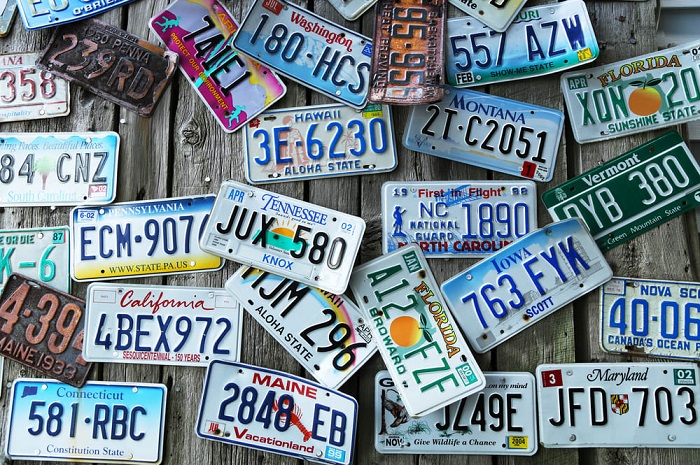
A box of fifty license plates can be a useful supply of material or an expensive collection of the wrong colors. The difference depends on the project. A large wall covering can accommodate repeated designs and ordinary road wear. A sign assembled from individual characters needs the right letters, enough intact metal around them, and a surface that will remain readable after cutting. Buying more plates does not automatically solve either problem.
For US buyers, these five dealers offer different ways to obtain real expired license plates in quantity: selecting multiples from stock, purchasing a defined assortment, requesting a custom order, or assembling a smaller group of individually pictured pieces. The useful comparison is what each order will contribute to the finished work. Treat a stated inventory count, a package count and a number shown in a photograph as separate pieces of information.
How the craft plate dealers were selected
The comparison considers lot composition, useful condition and the suitability of the delivered order. Sellers must offer real expired plates, rather than newly manufactured signs that imitate them. ShopLicensePlates is the featured starting point for choosing multiples by plate type. The remaining dealers progress from defined bulk assortments to custom project orders, broader bulk offers and individually selected craft stock. That order reflects purchasing needs; it does not claim that one seller has the lowest delivered price for every project. Product descriptions and merchant terms establish what is offered, while the buyer’s intended cuts, dimensions and color choices determine its usefulness.
Top 5 License Plate Dealers for Craft Supplies in Bulk
- ShopLicensePlates
A border built from repeated colors is easier to plan when its materials come from a defined design, and ShopLicensePlates sells real expired license plates in multi-quantity taxi, livery, truck and trailer stock. Work backward from the border’s length or the number of signs needed. Then price the required quantity of the chosen stock, allowing for any parts that the project cannot use. The design can stay consistent while the registration numbers vary.
Its Illinois taxi offer illustrates how that purchase works. The listed 2020 plates have green backgrounds and blue characters, and the seller describes them as washed and in good condition. The description expressly says the plate supplied will resemble the example but carry a different number. For a green-and-blue background, that variation may be welcome. For a sign that requires a particular sequence of characters, it is a reason to establish the required letters separately before ordering.
The large number in a bulk listing’s title describes available stock, not necessarily the contents of one package. A buyer should therefore check the quantity entered and the resulting order total instead of treating a low displayed price as the cost of the entire inventory. The same distinction matters when comparing these offers with a competitor’s fixed fifty-plate assortment: the purchasing units must match before the prices mean anything.
The return policy excludes bulk items and sale items from the ordinary return offer. Resolve questions about material, condition and quantity before committing the budget, particularly if the design depends on a consistent color or finish.
- RusticPlates
A fixed assortment makes planning easier when the project can absorb repeated states. RusticPlates offers a fifty-plate lot made up of ten plates from each of five states, with letters and numbers varying from the sample photograph. Picture five panels that each repeat one state’s design: this distribution may fit the work better than fifty different backgrounds. The current product description asks buyers to judge condition from the sample, so use that particular offer’s description when estimating material yield.
RusticPlates also separates roadkill, craft and good-condition material in its broader bulk range. These descriptions should guide the tolerance built into a materials estimate. A plate with damaged corners may still provide a sound central panel; damage across the desired lettering is a different problem. Do not assume that all plates within a condition class will yield the same amount of usable material.
For larger requests, the dealer invites buyers to specify states, quantities and condition. That option is worth considering when the published assortment is close to the requirement but would create avoidable leftovers. A clear request should explain what must be consistent and what may vary. It is easier to evaluate a proposed box when the seller knows that color matters, for example, but serial numbers do not.
- Plate Dog
Some projects begin with a drawing rather than a plate count. Plate Dog’s bulk service accommodates that approach: the merchant invites large orders for art projects and room decoration and describes supplying buyers in the United States and Canada. Its offer is a request-and-quote route, so the useful first step is to explain the intended result and obtain a proposed assortment.
A custom order should identify the number of whole plates, acceptable states or designs, required condition and any limits on duplicates. Those terms are not a standard package automatically attached to every bulk request. For an installation mixing many designs, a broad assortment may be attractive. For a set of matching panels, a more restricted selection may justify a different price. Plate Dog’s willingness to discuss a large order provides the purchasing route; the agreed contents determine whether that route fits the project.
Shipping is another reason to plan the order as a whole. The merchant publishes US brackets based on the number of plates and notes exceptions for some older, heavier examples. A quote for the complete selection gives a more useful cost than multiplying a single-plate shipping figure. Include any necessary extra material in that calculation, rather than discovering near completion that a small follow-up order costs disproportionately more.
There is also a destination-specific condition: Plate Dog restricts current-style plate sales into the New York City metropolitan area unless the purchaser is a known collector, while older designs remain available. A buyer in that region should make the destination and desired age range clear at the start. Older material can still serve a craft project well, but the seller’s restriction should be resolved before the design depends on current-style stock.
- USPlates
USPlates is a possible source for a buyer who wants a bulk supply and can tolerate variation within a design. Its homepage advertises bulk purchasing, explicitly refers to buying ten plates, and separately offers complete state sets. It also explains that letters, numbers and stickers can differ from its representative photographs unless the individual advertisement states otherwise. That distinction makes it more appropriate to evaluate a proposed bulk order by design and condition than by the exact characters visible in a sample image.
For a workshop, start with the part that will survive the cut. If the finished pieces use the background and a strip of state lettering, variable serials may contribute no waste at all. If each piece needs a particular large character, the same box has an uncertain yield. That difference explains when USPlates’ representative-photo stock fits the budget and when individually chosen plates, such as those at Tag Shack below, can be the more economical supply.
The homepage’s reference to ten plates should not be read as one universal ten-plate product with a guaranteed state mix. Establish the actual count and composition of the chosen offer, including whether duplicates are expected. The seller’s domestic shipping page uses plate-count brackets for combined orders, which makes it sensible to compare the completed basket rather than isolated item prices.
- Tag Shack
Tag Shack takes the comparison back to the individual object. The merchant describes its craft stock as genuine, previously issued and expired, and says the customer receives the particular tag pictured. For a project with awkward final requirements, that can be useful: a specific color, an intact area around a character, or an unusual vehicle designation may matter more than obtaining the largest possible mixed lot.
Its wholesale and bulk pricing language does not establish a standard packet containing a fixed number of different states. Think of the offer as a way to assemble the required group from selected stock. Looking closely at each image takes longer than accepting a ready assortment, but it can reduce the number of unsuitable pieces when the design has little room for substitutions. The general flat-rate shipping promotion has exceptions: the detailed policy says charges for pairs, lots, grab bags and crafts can vary. Use the total for the actual craft selection, rather than carrying the headline rate into the materials estimate.
This is a narrower purchasing task than filling a workshop with general material. Imagine that a mostly completed project needs two contrasting backgrounds and a plate with a particular character intact. Choosing those objects individually may cost more per plate yet require less spending overall than another large mixed box. The important comparison is the cost of finishing the work, including unused leftovers, rather than the cheapest nominal unit price.
Turning the order into a usable materials budget
Before buying, decide which features must match and which can vary. Then divide the delivered order cost by the number of plates you realistically expect to use. As an illustration, an order costing $120 that provides twenty useful plates costs $6 per useful plate, even if the box contains thirty. That calculation is a planning example, not a price quoted by any of these dealers.
Leave room for damaged areas and test the layout before cutting. Whole plates that turn out to be unsuitable for one design may suit another, but potential future use should not disguise a poor fit for the current project. Choose a fixed assortment when its repetitions help, a custom request when the contents need discussion, and selected objects when exact visual details matter. The best bulk order is the one whose contents you can explain before it reaches the workbench.
Source note: This comparison draws on the dealers’ bulk offers, individual product descriptions, shipping pages and return terms. Descriptions of originality and condition are the merchants’ statements; listed stock and assortment availability can change.